

 App Store
 Profile
 Security
 Sign Out
 Feeds
Feeds
 Articles
X402 Explained: Turning the “Payment Required” Code Into the Future of AI Transactions
 Jarrod Watts
x402 explained - is it all hype?

x402 coins skyrocketed to over ~$100M market cap yesterday, seemingly blowing up out of nowhere; despite the protocol being released several months ago.
I spent the day building my x402 server to find out if it's just another quick crypto cash grab in the ai bubble, or something that can change the way AI agents interact with the internet.
Here's what I learned:
The fundamentals: APIs & status codes
Real quick, there's some foundations we first need to cover for all of our non-devs here before we can continue: mainly APIs & status codes.
If you're already bored, don't give up yet, it's actually very simple.
All you need to know is: clients (e.g. an app, or an ai agent) use APIs to request information from servers (aka. a "backend"), and they respond with a status code + some data.
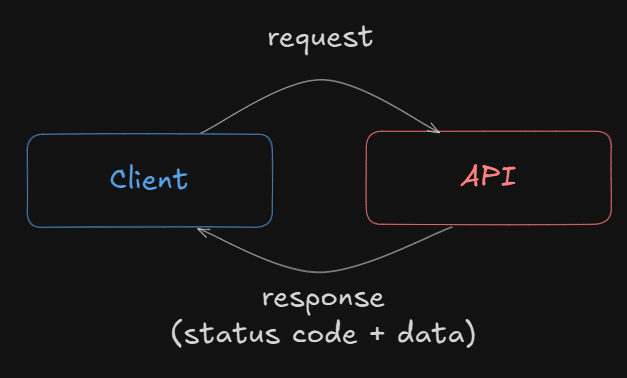
Each status code has a different meaning, and 402 is one of the status codes that a server can respond with. Some examples:
200 = OK (gives back data successfully)
404 = Not Found (failure)
402 = Payment Required
The thing is, the 402 "payment required" response code is almost never actually used today - as a dev, I'd never even heard of it before.
One more thing. To use most APIs today, developers have to sign up for that API's developer platform, put their credit card information in, and are charged based on their API usage (tied to a unique API key).
So with this in mind, what is x402, why does it exist, and how does it work?
x402: what, why & how?
TLDR: some nerds over at Coinbase said, "hey, so we have AI agents now, and we also have crypto, what if we made this 402 code actually useful?"
x402 extends the original 402 status code, and instead of just returning a useless message, actually enables payments directly inside of the API request, typically by using stablecoins.
This allows APIs to require clients to pay a fee to use the API endpoints, and clients can pay those fees directly as part of the request using crypto.
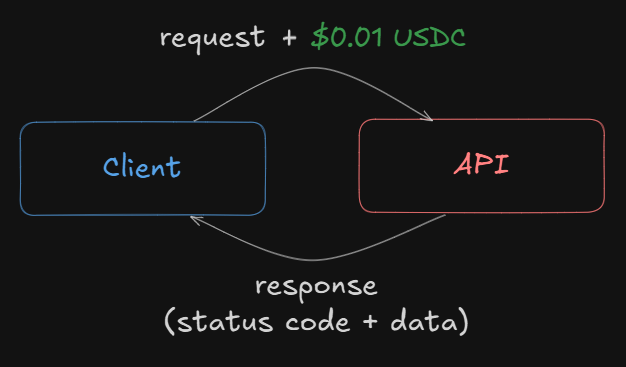
Your next question might be - but how does crypto actually get transferred inside an HTTP request? Does every API have to now write code for handling transactions on-chain?
Well, they *can*, or alternatively, they can outsource the on-chain payment processing to what's called a "facilitator".
Facilitators are simply service providers that takes the client's authorization to spend money, quickly checks it is legit, and then executes the payment on-chain.
They exist to make it easier for API developers to adopt x402 in their APIs.
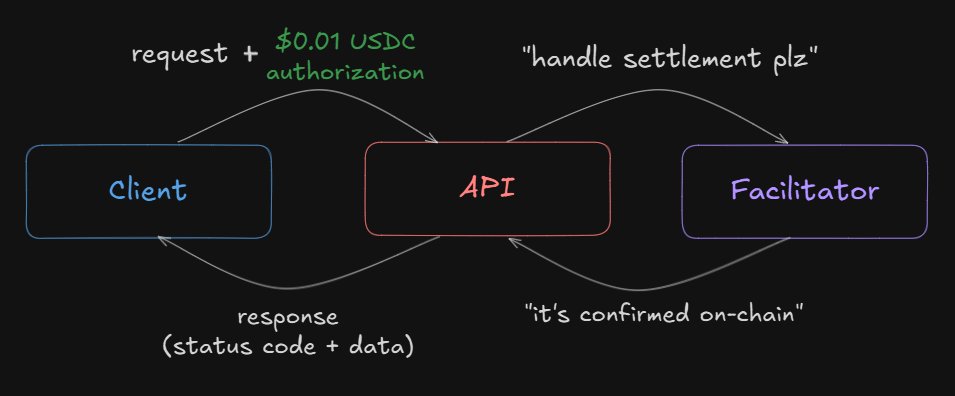
How x402 Unlocks AI Agents
Traditional payment methods don't really work for AI agents... today's payment rails require a bunch of human setup and maintenance for agents to actually use them.
Interacting with paid APIs today requires signing up for individual developer platforms, paying for each one with a credit card, and maintaining unique API keys - all of which require human intervention.
x402 kills the API key by enabling payments directly over HTTP request, making it easy for AI agents to access information from paid APIs without any human setup beforehand.
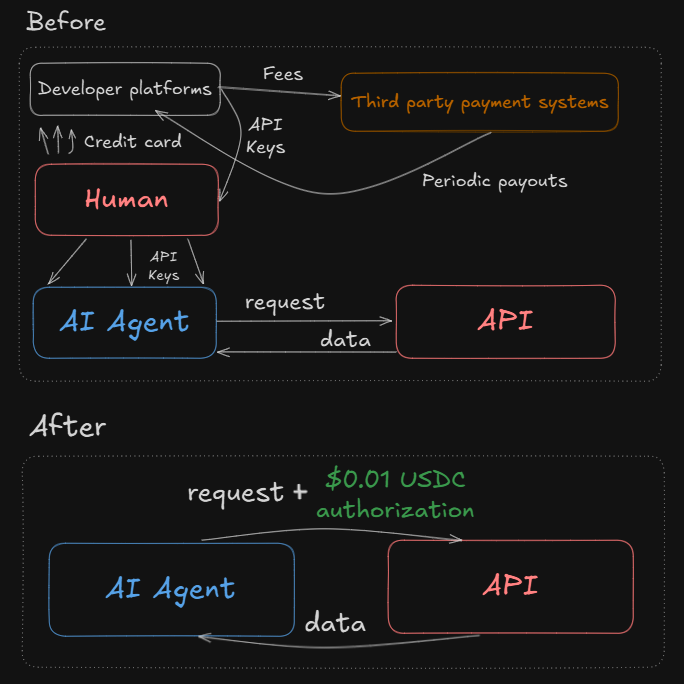
In the process, it cuts out the middlemen like credit cards & third party payment providers who take massive fees throughout this exchange.
What about x402 coins?
I think there are three key areas that new coins fit into this:
APIs requiring payment to be made in <api token name>, rather than accepting stablecoins from clients - somewhat interesting.
Facilitators requiring APIs to pay them in <facilitator coin name> for their services - this exists already but feels quite weak.
Speculative tokens like we saw last AI hype cycle.
In the last hype wave, we saw AI coins reach billions of dollars in market cap. Those AI coins essentially had absolutely zero point of existing, often just having a loose association to an annoying twitter bot.
x402 coins feel the same. But the key here is not to ask "why does this token need to exist?", and instead, accept that a large chunk of CT are here to try make money, and coins create perfect markets to do that.
I suspect we'll see a new wave of AI coins pop up over the next few weeks to ride this hype. And, again, they'll likely be completely pointless, but “would you rather be right or rich?”
Closing Thoughts
x402 is an innovative technology that is actually relevant to crypto, presenting a very powerful use case for stablecoins to enable AI agents to interact with the internet natively.
I suspect we'll soon see an intersection of x402 payments, ERC-8004 trustless agents, and potentially verifiable AI to utilize blockchains permissionless nature to give further reputation and trust to AI - a topic for another article.
Crypto really feels like it's starting to finally arrive with some fun consumer apps, stablecoins, and institutional adoption, and x402 is another step in the right direction. It's very refreshing.
- Jarrod
 Source
 Add to Favorites
 Download image
 Share x
 Copy link
Bitcoin may enter a prolonged sideways phase between $57K and $87K as markets enter a relief period following a 52% drop from ATH. This consolidation could mirror the 2022 fractal, creating liquidity before a potential breakdown toward the $44K–$50K range.
Doctor Profit/2026.03.09

Davinci Jeremie urged people to buy $1 of Bitcoin in 2013 and became a symbol of early conviction. Years later, fame, lifestyle flexing, and token promotions sparked criticism. His journey reflects both crypto foresight and influencer-era controversy.
StarPlatinum/2026.03.04
A sweeping narrative ties Jane Street to India’s expiry-day options case, alleged 10AM Bitcoin sell patterns, Terra’s collapse, and ETF plumbing. While none prove misconduct, critics argue a common structure: move spot, monetize derivatives, keep execution opaque.
Bull Theory/2026.02.27
A controversial narrative links Jane Street, ETF mechanics, and Bitcoin’s price behavior, pointing to lawsuit allegations, 10AM volatility patterns, and derivative hedging dynamics. The discussion raises broader questions about liquidity, structure, and price discovery.
Justin Bechler/2026.02.26
A new federal lawsuit alleges Jane Street exploited non-public information tied to Terraform’s liquidity defenses, accelerating UST’s depeg and the Terra collapse. The firm denies the claims. The case may reignite debates on structure, design, and regulation.
Diana/2026.02.25
Mean reversion and on-chain models sit at levels historically linked to bottom formation after capitulation. Realized losses reached record USD values, while deviations from anchor models remain extreme. Price pain may be fading; patience remains key.
Checkmate/2026.02.25
Hot feeds
A trader profits $448K by monitoring #Binance's new listings!
2024.12.13 17:37:29
Last week, funds have flowed into #Bitcoin, #Ethereum, and #Hyperliquid.
2024.12.16 14:48:36
A $PEPE whale that had been dormant for 600 days transferred all 2.1T $PEPE($52M) to a new address.
2024.12.14 10:35:27
When Elon Musk tweeted about Moltbook, the meme coin MOLT experienced a short-term 30% price surge, hitting a new all-time high of $114 million.
2026.01.31 18:37:29
A smart #AI coin trader made $17.6M on $GOAT, $ai16z, $Fartcoin,$arc.
2025.01.05 16:05:18
A sniper earned 2,277 $ETH ($8.3M) trading $SHIRO within 18 hours!
2024.12.03 23:09:08
MoreHot Articles
How did I turn $1,000 into $30,000 with smart money?
2024.12.09
10 promising AI Agent cryptos
2024.12.05
The 30-Year-Old Entrepreneur Behind Virtual, a Multi-Million Dollar AI Agent Society
2025.01.22
10 smart traders specializing in MEMEcoin trading on Solana
2024.12.09
A trader lost $73.9K trading memecoins in just 3 minutes — a lesson for us all!
2024.12.13
What is $SPORE? Let us take you through the on-chain records to show you how it works.
2024.12.25

