

 App Store
 Profile
 Security
 Sign Out
 Feeds
Feeds
 Articles
The Ultimate Swing Trading Playbook: How Concentration and Volume Drive Big Wins
 Kevin Xu
Guide to Ultimate Swing Trading
I went $35K to $8M in 21 months by going all-in 1 stock at a time.
I did this mainly via "swing trading".
Here's how it works:

What is swing trading?
This is not investing.
And it's not day trading.
I picked single stocks and plowed every dollar into shares.
Held positions for days to weeks to months sometimes.
Watching the charts and praying everyday.
Or exiting if all hope is lost.
Volume is very important
The #1 thing I look at is volume.
To me, volume is a measurement of how many people care about this stock. Increase in volume is generally good while decrease is bad.
I specifically look out for these two things:
Was there a mid-day increase in volume all of a sudden? Pay attention
Was there some positive news or an increase in social chatter but the stock doesn’t seem to be moving? Don’t bother
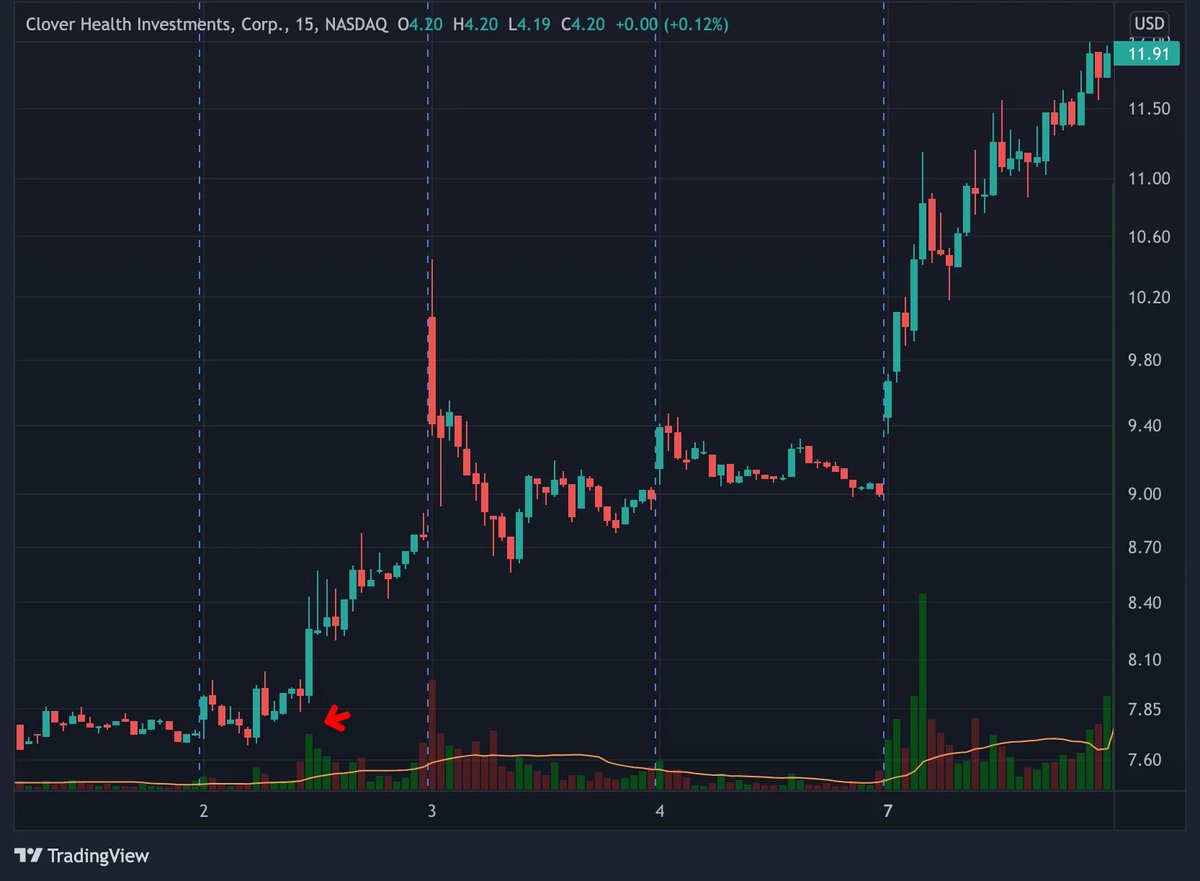
CLOV here is a good example of a mid-day volume spike.
If the average volume remains elevated and volume continues to increase then it’s very good. It could imply another pop to come like it did a few days later.
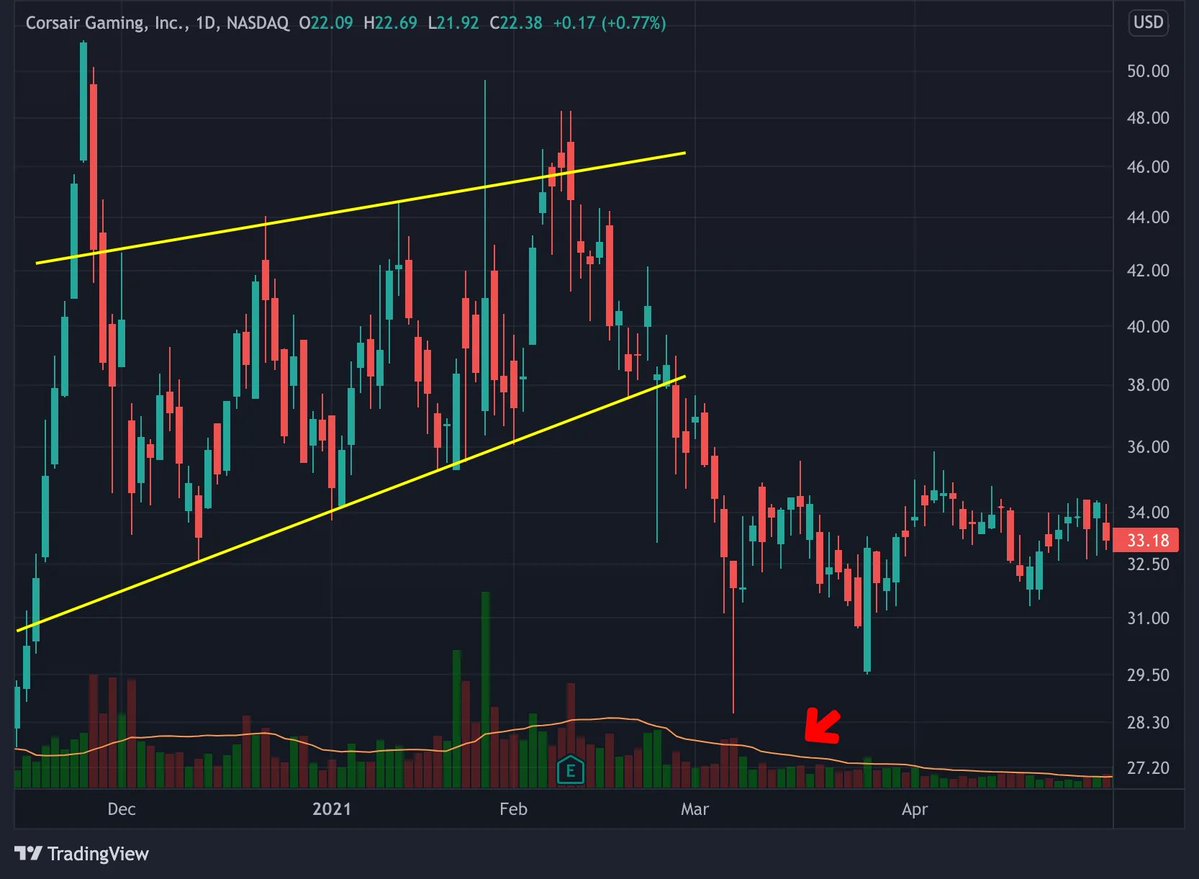
CRSR was the opposite.
No matter what new products or analyst price targets came out, volume just kept decreasing, implying people don’t care much about this company as much anymore.
Attention moves price long before fundamentals do.
Catalysts are super important
There has to be a story.
Some interesting catalyst that gives people “hope” in the short-term for upwards price movement.
Combined with an increase in volume, that makes a good swing stock.
Like:
Potential ETF inclusions
Biotech and FDA approvals
Earnings coming up
Keynote speeches and conference talks
Basically with each catalyst I think about the potential of it happening, how soon it might happen, how much will it impact the stock price, what happens if it doesn’t happen (do you still like the company?), and why hasn’t the market already priced it in?
Having a real understanding of the actual company and industry helps a lot with this. Knowing how long it takes to launch a new partnership or what’s really going on with the supply chain can give you an edge rather than just reading headlines and secondary sources about the company.
Draw a support line
It's really simple.

SKLZ for example here fell back to it’s 2020 support line after a crazy rollercoaster of a year and bounces around on it.
I like long declines like this because it implies to me “all the bagholders have finally given up and left” thus free-ing the stock for a potential reversal or bounce.
SKLZ did indeed bounce off the support line which made a great scalp.
Is the thesis alive or dead?
Every day I asked one question:
Is the reason I’m in this trade still true?
If yes, I stayed.
If not, I sold.
I'm totally okay sitting on a -10% loss for months if the thesis is still alive.
But if volume fades or the catalyst fails, then hope is gone.
Don't marry a stock. Just sell it and move on to the next one.
Patience wins
TBH most of the time nothing is happening.
I only made like 18 trades that year.
You're just processing information and waiting.
Then occasionally something stands out.
A volume change.
A reaction that doesn’t make sense.
And it’s time to make a move.

Ultimate Swing Trading
"Diversification may preserve wealth, but concentration builds wealth" - Warren Buffett
My version of swing trading is to basically go all-in with everything you have on your highest conviction stock.
Just 1 stock.
It's so simple.
Highly recommend it.
 Source
 Add to Favorites
 Download image
 Share x
 Copy link
Davinci Jeremie urged people to buy $1 of Bitcoin in 2013 and became a symbol of early conviction. Years later, fame, lifestyle flexing, and token promotions sparked criticism. His journey reflects both crypto foresight and influencer-era controversy.
StarPlatinum/12 hours ago

A sweeping narrative ties Jane Street to India’s expiry-day options case, alleged 10AM Bitcoin sell patterns, Terra’s collapse, and ETF plumbing. While none prove misconduct, critics argue a common structure: move spot, monetize derivatives, keep execution opaque.
Bull Theory/5 days ago
A controversial narrative links Jane Street, ETF mechanics, and Bitcoin’s price behavior, pointing to lawsuit allegations, 10AM volatility patterns, and derivative hedging dynamics. The discussion raises broader questions about liquidity, structure, and price discovery.
Justin Bechler/6 days ago
A new federal lawsuit alleges Jane Street exploited non-public information tied to Terraform’s liquidity defenses, accelerating UST’s depeg and the Terra collapse. The firm denies the claims. The case may reignite debates on structure, design, and regulation.
Diana/7 days ago
Mean reversion and on-chain models sit at levels historically linked to bottom formation after capitulation. Realized losses reached record USD values, while deviations from anchor models remain extreme. Price pain may be fading; patience remains key.
Checkmate/7 days ago
Bitcoin didn’t fail as an asset — it matured into an ETF-driven trade. As institutional ownership rose, correlation with tech risk intensified. Short-term pressure reflects holder structure shifts, not thesis collapse.
Eric Jackson/2026.02.24
Hot feeds
A trader profits $448K by monitoring #Binance's new listings!
2024.12.13 17:37:29
A smart #AI coin trader made $17.6M on $GOAT, $ai16z, $Fartcoin,$arc.
2025.01.05 16:05:18
When Elon Musk tweeted about Moltbook, the meme coin MOLT experienced a short-term 30% price surge, hitting a new all-time high of $114 million.
2026.01.31 18:37:29
Last week, funds have flowed into #Bitcoin, #Ethereum, and #Hyperliquid.
2024.12.16 14:48:36
A $PEPE whale that had been dormant for 600 days transferred all 2.1T $PEPE($52M) to a new address.
2024.12.14 10:35:27
A sniper earned 2,277 $ETH ($8.3M) trading $SHIRO within 18 hours!
2024.12.03 23:09:08
MoreHot Articles
How did I turn $1,000 into $30,000 with smart money?
2024.12.09
10 promising AI Agent cryptos
2024.12.05
The 30-Year-Old Entrepreneur Behind Virtual, a Multi-Million Dollar AI Agent Society
2025.01.22
10 smart traders specializing in MEMEcoin trading on Solana
2024.12.09
A trader lost $73.9K trading memecoins in just 3 minutes — a lesson for us all!
2024.12.13
What is $SPORE? Let us take you through the on-chain records to show you how it works.
2024.12.25

