Fourteen publicly listed companies have collectively offloaded 108,000 BTC so far this year, with a total value of approximately $8.08 billion.
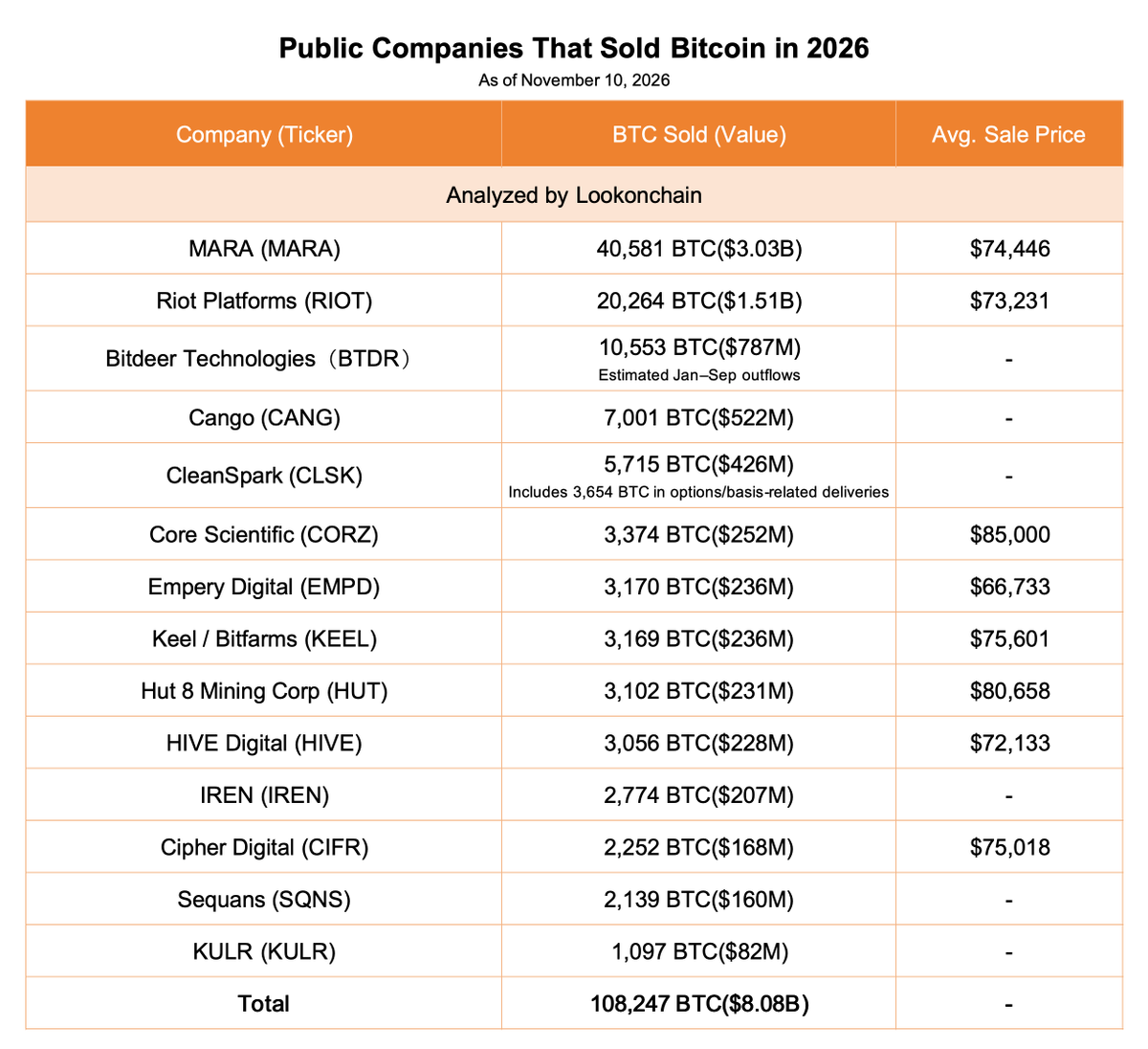
According to Lookonchain's monitoring, as of the reporting date, 14 publicly listed companies have collectively sold 108,247 BTC since the start of 2026, worth approximately $8.08 billion. Breakdown by company:
· MARA sold 40,581 BTC, valued at around $3.03 billion, at an average price of $74,446;
· Riot Platforms sold 20,264 BTC, worth approximately $1.51 billion, with an average selling price of $73,231;
· Bitdeer Technologies sold 10,553 BTC, valued at about $787 million; this figure is an estimate of outflows between January and September;
· Cango sold 7,001 BTC, worth approximately $522 million;
· CleanSpark sold 5,715 BTC, valued at around $426 million, including 3,654 BTC delivered in connection with options or basis trades.
The five companies above collectively sold 84,114 BTC. Other sellers include Core Scientific (3,374 BTC, average price $85,000), Empery Digital (3,170 BTC), Keel/Bitfarms (3,169 BTC), Hut 8 Mining (3,102 BTC, average price $80,658), HIVE Digital (3,056 BTC), IREN (2,774 BTC), Cipher Digital (2,252 BTC), Sequans (2,139 BTC), and KULR (1,097 BTC).
10 minutes ago
Google used AI to complete a mathematical proof for the Signal Protocol in just four weeks, and also uncovered vulnerabilities in older versions of the protocol.
Beating AI News: Google DeepMind has developed an AI system called AlphaProof Code, which took just four weeks to mathematically verify some core security guarantees of the Signal encryption protocol. Conventional security tests only check limited scenarios; failing to uncover vulnerabilities does not mean they are absent. Mathematical proofs are far more rigorous: they first formalize the software’s required security specifications into mathematical formulas, then prove these specifications hold consistently under defined conditions. Historically, such proofs required experts to invest massive time in manual derivation. AlphaProof Code allows AI to independently attempt proofs, revise its approach when it detects flaws in the derivation, and proceed with verification. Human experts oversee auditing of critical steps. Researchers also tested the system on an older version of Signal that had known vulnerabilities. The AI successfully identified these long-resolved issues and confirmed the old version could not pass the corresponding mathematical proof. For the current protocol segment examined, the AI found no new vulnerabilities.
10 minutes ago
OKX Flash Earn Lite is launching NIGHT's "staking to earn" program, with users able to split a 12.5 million NIGHT reward pool.
Official announcement: OKX’s Flash Earn Lite will launch the NIGHT (Midnight) “Stake-to-Earn” campaign from 15:00 UTC+8 on November 11, 2026, to 15:00 UTC+8 on November 24, 2026. During the event, users can lock BTC, SOL, OKB, or NIGHT to subscribe, and will split a total of 12.5 million NIGHT in airdrop rewards. Pre-subscriptions are now open, with rewards starting to be calculated from the official kickoff of the campaign. Users can participate via the “Flash Earn” entry at the top of the OKX App’s Explore page.
10 minutes ago
Bakkt’s third-quarter revenue fell 62.9% year-over-year to $150 million, turning a net profit of $14.3 million.
According to The Block, Bakkt (ticker: BKKT) released its third-quarter 2026 financial results. The quarter’s total revenue hit $149.2 million, a 62.9% year-over-year decline from $402.2 million in Q3 2025, primarily driven by lower cryptocurrency trading volumes. The company’s total trading volume for the quarter stood at $147.9 million, reaffirming its target of roughly $3 billion in full-year 2026 trading volume while setting a new goal of $6 billion for H1 2027.
Net profit attributable to Bakkt for the quarter was $14.3 million, with diluted earnings per share (EPS) of $0.31, compared to a net loss of $14.9 million and a loss per share of $1.15 in Q3 2025. The quarter included a $26.8 million non-cash gain related to Transchem warrants, and operating loss from continuing operations narrowed 42.9% to $14.4 million. Adjusted EBITDA loss was $11.8 million, an improvement of $3 million from the comparable year-ago loss of $14.8 million.
Operating expenses, excluding crypto costs and execution, clearing, and brokerage fees, totaled $16.1 million, down 39.7% YoY, mainly due to lower compensation, professional services, and administrative expenses, plus the absence of $5.6 million in restructuring and impairment charges, partially offset by a $1.7 million increase in amortization of acquired intangible assets.
As of September 30, 2026, Bakkt’s cash, cash equivalents, and restricted cash stood at $37.3 million, down from $50.7 million as of June 30. The quarter saw a net cash outflow from operating activities of $17.9 million, and the company did not sell shares under its at-the-market offering plan during the period. Bakkt noted it currently has no long-term debt.
Crypto service revenue is reported on a gross basis, largely offset by crypto costs and execution, clearing, and brokerage fees, which reached $147.5 million for the quarter (down 63.2% YoY). Total operating expenses were $163.6 million, a 61.7% YoY decrease.
10 minutes ago
Bloomberg: Kimi has leased top-tier NVIDIA B300 chips in China, with 32 servers valued at 432 million yuan.
Beating AI News Brief: According to Bloomberg, Chinese AI startup Moonshot (Kimi) has successfully obtained access to NVIDIA’s top-tier B300 chips in China. Bloomberg obtained two financing contracts filed with regulatory databases, showing that 32 Supermicro servers equipped with B300 chips are located in Qingyang, Gansu Province, with a total valuation of 432 million yuan. The B300, part of NVIDIA’s Blackwell Ultra series, is a high-end AI chip subject to strict U.S. export restrictions to China. The average valuation per server is 13.5 million yuan, roughly 350% higher than the market price of comparable U.S.-made products. The contracts were signed in August this year.
The servers are held by Lingmeixin (Beijing) Technology Co., Ltd., which secured a 200 million yuan loan from Beijing Zhongguancun Bank. Collateral for the loan includes the servers as well as a computing power service contract signed with Moonshot, involving 345.6 million yuan in expected revenue. Lingmeixin was previously engaged in businesses such as drones and computer vision. It purchased the servers from a newly established subsidiary of Beijing Chunju Technology, a firm that was previously focused on e-commerce for liquor products like Moutai before expanding into AI operations.
The documents do not disclose where these U.S. export-controlled servers were originally sourced. After Bloomberg reached out to Moonshot, Lingmeixin, and the bank on November 3, Moonshot’s name was removed from the relevant regulatory documents. Moonshot denied involvement in or authorization of the financing and collateral arrangements, stating that it currently has no business relationship with Lingmeixin and was unaware of these deals. NVIDIA and Supermicro said the companies involved in the procurement are not their clients.
10 minutes ago


 App Store

 Profile
 Security
 Sign Out

 Feeds

 Articles
 Source

 Add to Favorites
 Download image
 Share x
 Copy link


