Lookonchain APP

App Store

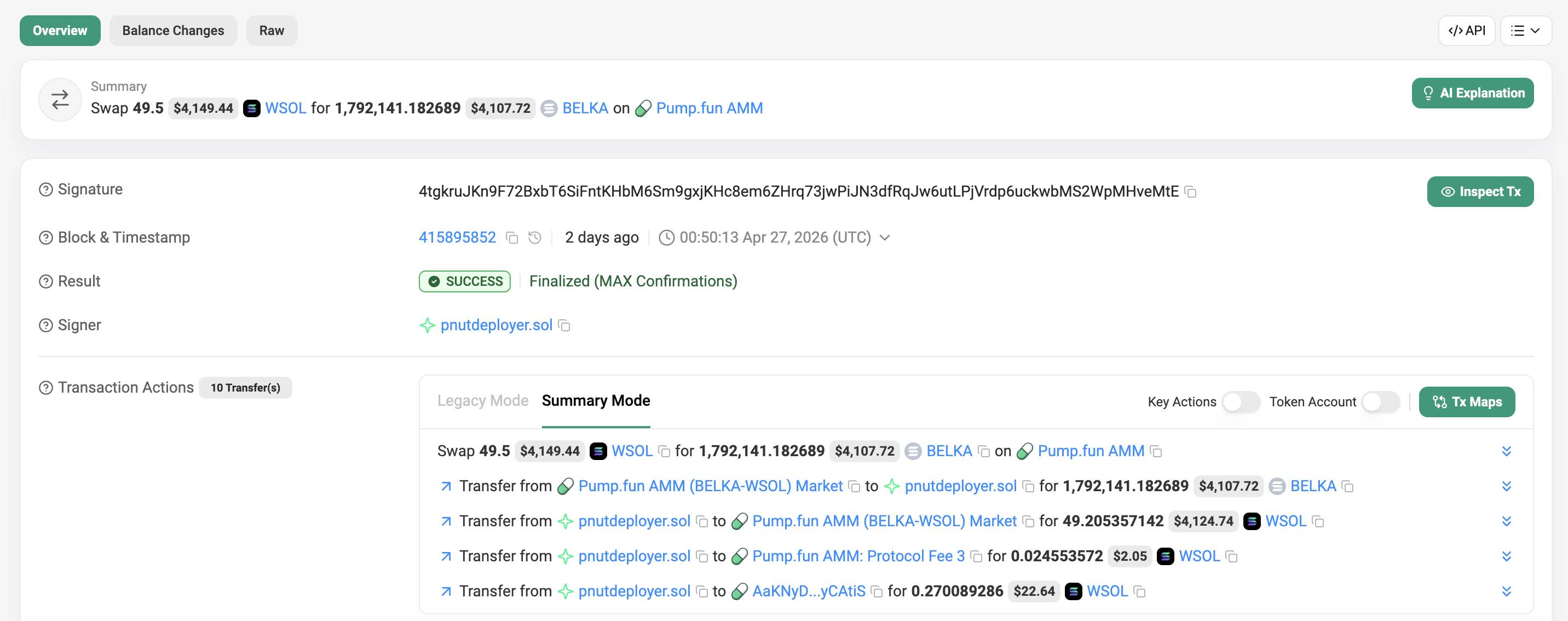
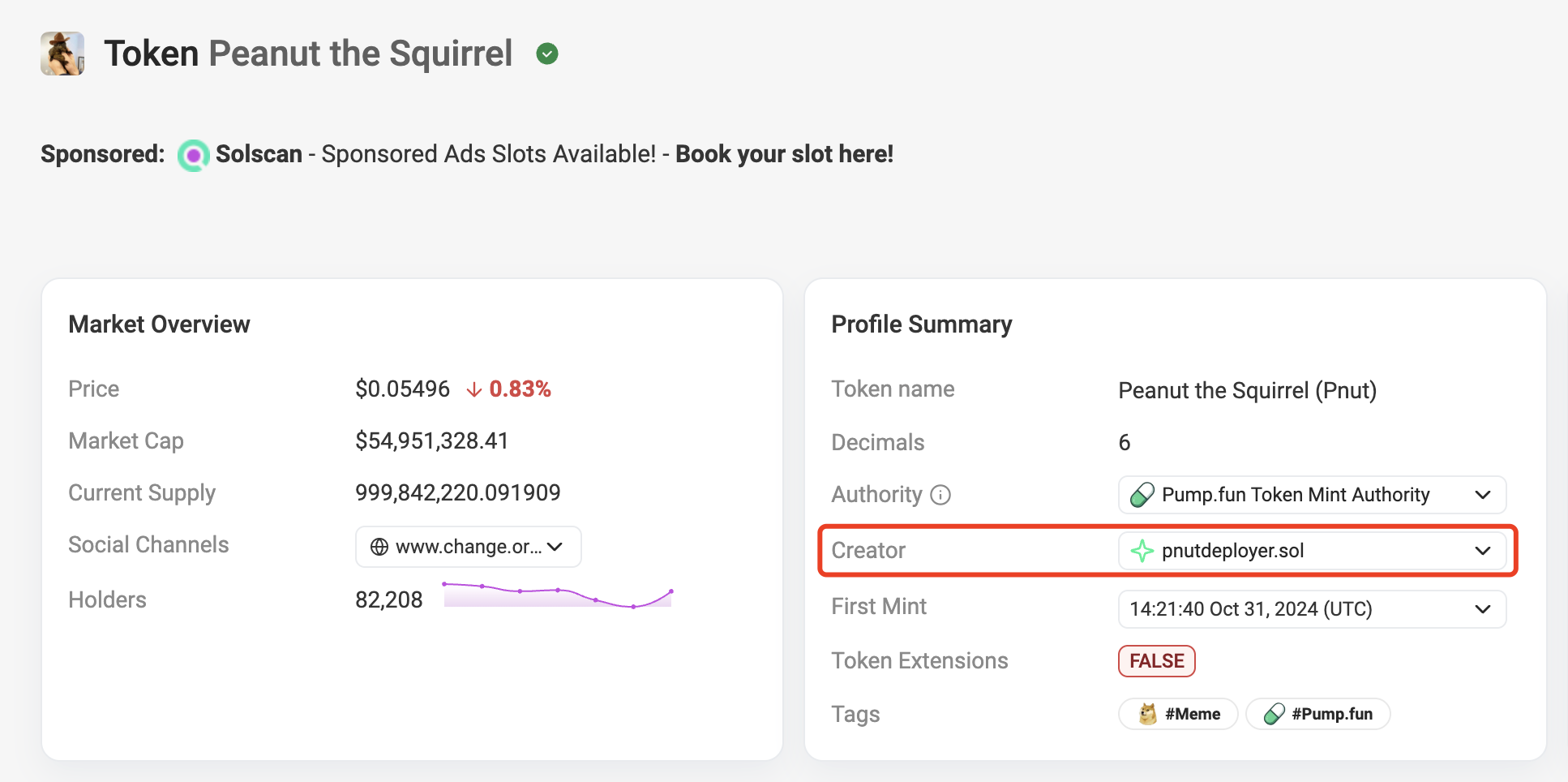
The deployer of $PNUT (pnutdeployer.sol) spent 49.5 $SOL ($4,341) to buy 1.79M $BELKA.

2026.04.29 07:32:36

The deployer of $PNUT (pnutdeployer.sol) spent 49.5 $SOL ($4,341) to buy 1.79M $BELKA.

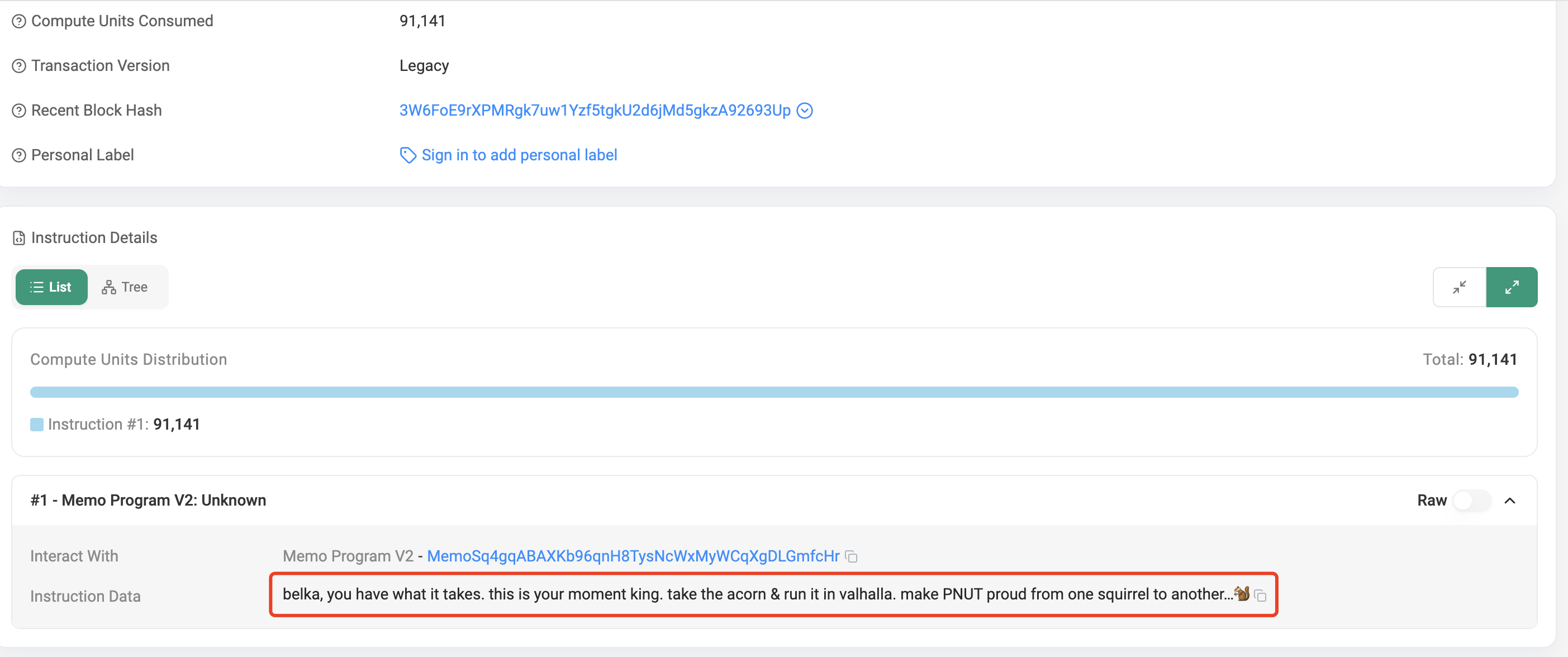
pnutdeployer.sol also sent an on-chain message:

"belka, you have what it takes. this is your moment king. take the acorn & run it in valhalla. make PNUT proud from one squirrel to another…🐿️ "
https://solscan.io/tx/4tgkruJKn9F72BxbT6SiFntKHbM6Sm9gxjKHc8em6ZHrq73jwPiJN3dfRqJw6utLPjVrdp6uckwbMS2WpMHveMtE

https://solscan.io/tx/TxNLa58mtZQRuQUgJNZ3VAyEkHw2SmASv8Gx9phfvRkuCYwNhmtbmCXrz8bs56ijuM14HsKNCxNrFH19ejFHSCc

Relevant content

Yilihua: July and August will be the best time to buy the dip, and this will be Bitcoin’s final major pullback.

Liquid Capital (formerly LD Capital) founder Yilihua stated, “This marks the third wave of decline since 1011. Per wave theory and cycle patterns, this will be Bitcoin’s final major downturn. The key factors driving Bitcoin’s bottom price that everyone is concerned about are US stocks and MicroStrategy. It remains unclear whether the Federal Reserve’s CPI concerns will shift expectations for interest rate cuts or even hikes, which could trigger sustained pullbacks in US equities. Additionally, past bear market tails often witness black swan events or major blowups, which have not materialized this time and require close monitoring. Calculated based on Bitcoin’s all-time high of $126,000, a 60% drop would reach $51,000, while a 66% decline would hit $43,000. Either way, July to August should be the final window—both the best time to buy the dip and the most worthwhile trading opportunity in the next three years.”

1 seconds ago

South Korean crypto exchange Bithumb introduces a securities firm as a shareholder, with Kiwoom Securities seeking to take a stake via private placement.

South Korea's Kiwoom Securities is in talks with crypto exchange Bithumb regarding a private placement of new shares, intending to take a stake by subscribing for new shares; the specific shareholding ratio and investment amount are still under negotiation. After Samsung, Mirae Asset, and Korea Investment & Securities, another major securities firm has joined the race for stakes in the crypto exchange. Against the backdrop of this potential stake acquisition, South Korea's financial regulators are advancing the second-phase reform of the Virtual Asset Act, which proposes setting a cap of 20% on shareholdings of major exchange shareholders in principle, with exceptions allowing up to 34%. Bithumb's current largest shareholder, Bithumb Holdings, holds a 73.56% stake, and would face significant pressure to reduce its holdings if the rules take effect. Bithumb is currently advancing its KOSDAQ listing plan, with Samsung Securities as the lead underwriter, and is boosting its valuation by splitting its core trading business and new business segments. Whether Kiwoom Securities' private placement constitutes pre-IPO strategic financing, and how the deal aligns with the listing timeline, are expected to be core issues in the transaction structure. Bithumb stated that it is currently exploring cooperation with financial institutions and enterprises across various possibilities, with no specific plan finalized yet.

1 seconds ago

Wall Street is collectively bearish on the euro, with major banks including JPMorgan Chase forecasting the common currency will drop more than 3% over the next year.

Multiple major Wall Street banks have sharply cut their EUR/USD forecasts. JPMorgan, Morgan Stanley, and BNY Mellon all project the euro will fall more than 3% to around 1.10 over the next year. The single currency has hit a one-year low this month, a stark contrast to its five-year high above 1.20 reached earlier this year. Policy divergence is the core driving factor. New Federal Reserve Chair Waller has signaled a hawkish stance on fighting inflation, leading markets to reprice in rate hikes this year; ECB President Christine Lagarde, meanwhile, has said no aggressive policy response is needed to the Middle East conflict, keeping the central bank’s path relatively dovish. Escalating tensions with Iran have pushed up oil prices and boosted demand for the U.S. dollar, further eroding the euro’s support. Options market signals have also weakened, with the one-year risk reversal indicator falling to its most bearish level since March 2025. Societe Generale’s chief FX strategist bluntly noted that “the euro’s rally is essentially over,” and compared the current energy shock to the severe blow Europe’s economy suffered after the 2022 Russia-Ukraine conflict. Bank of America, while cutting its year-end forecast from 1.20 to 1.15, still maintains a “neutral” view, making it one of the few relatively dovish voices.

1 seconds ago

The Ansem wallet holds 604 million ANSEM tokens, with a market capitalization exceeding $71 million.

According to Lookonchain's monitoring, as ANSEM's price continues to climb, the 604 million ANSEM tokens held in the wallet of prominent crypto KOL Ansem (@blknoiz06) are now valued at over $71 million.

1 seconds ago

While Middle East tensions remain volatile, market reactions have grown increasingly muted, with investors shifting their focus to tech stocks.

The U.S. carried out fresh strikes on Iranian military targets over the weekend, while Iran attacked vessels near the Strait of Hormuz and launched missiles and drones toward Kuwait and Bahrain, temporarily halting U.S.-Iran ceasefire talks. However, the two sides later agreed to resume a cessation of hostilities and advance technical negotiations related to the ceasefire memorandum (MOU). Affected by the tensions, international oil prices edged higher, with Brent crude and WTI crude rising to around $72.31 and $69.82 respectively. Global financial markets overall showed limited reaction, as investors shifted their focus to the recovery of the tech sector. Demand for AI computing power has kept driving a persistent shortage of storage chips. Large tech firms including Apple and Microsoft can offset costs via price hikes, while some small and medium-sized enterprises (SMEs) face greater pressure. Meanwhile, SpaceX is poised to become one of the fastest companies in history to be included in the Nasdaq 100 Index.

1 seconds ago

Samsung and SK Group plan to invest $1.3 trillion over the next decade to bet on AI and semiconductors, with both companies’ stocks suffering sharp declines at the opening bell.

South Korean media has disclosed that Samsung Group and SK Group are developing a 10-year capital expenditure plan totaling around 2,000 trillion won (approximately $1.3 trillion), which is included in President Lee Jae-myung’s "Three Leap Projects" industrial strategic framework. The two conglomerates are expected to formally announce the plan to the presidential office on Monday afternoon. Funds will be focused on semiconductor capacity expansion, AI data centers and physical AI sectors. Each group plans to build 4 to 5 wafer fabs in Gwangju, and expand packaging and NAND capacities in North and South Chungcheong Provinces. However, the massive investment plan failed to boost market confidence. On Monday, South Korea’s KOSPI index extended its decline to 3%, Samsung Electronics dropped 5%, SK Hynix fell 4.5%, and KOSDAQ futures triggered a circuit breaker after surging 6%. Analysts believe investors are skeptical about whether AI-related capital expenditure will deliver actual returns. A research report from China International Capital Corporation (CICC) also noted that onshore leverage in South Korea’s stock market has reached a historical high, with recent margin call pressures rising, and market volatility risks cannot be ignored.

1 seconds ago