

 App Store
 Profile
 Security
 Sign Out
 Feeds
Feeds
 Articles
Jane Street and Terra: Revisiting the UST Collapse Through New Allegations
 Diana
Diana

Was Jane Street the Secret Villain Behind Terra's $40 Billion Crypto Catastrophe?
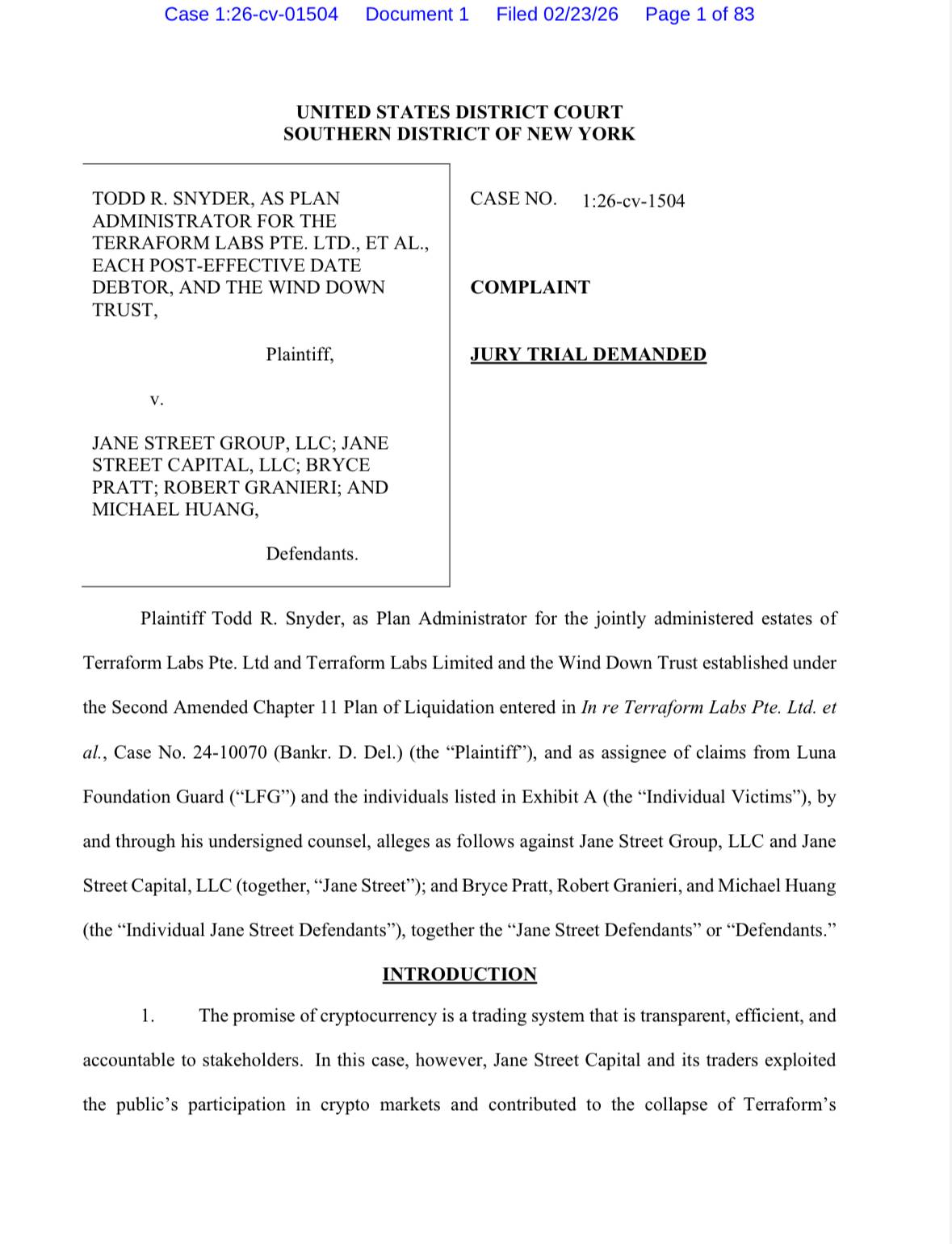
In a development that could reshape perceptions of one of cryptocurrency's most infamous failures, a federal lawsuit filed on February 23, 2026, accuses quantitative trading firm Jane Street of exploiting confidential information to accelerate the depegging of Terra's UST stablecoin, contributing to a $40 BILLION market wipeout.
The Sequence of Events, According to the Suit
According to the complaint (filed in Manhattan federal court, Case No. 1:26-cv-1504), Jane Street obtained confidential details about Terraform's emergency moves through insider connections – including employees like Bryce Pratt and Michael Huang, plus co-founder Robert Granieri named in the suit.
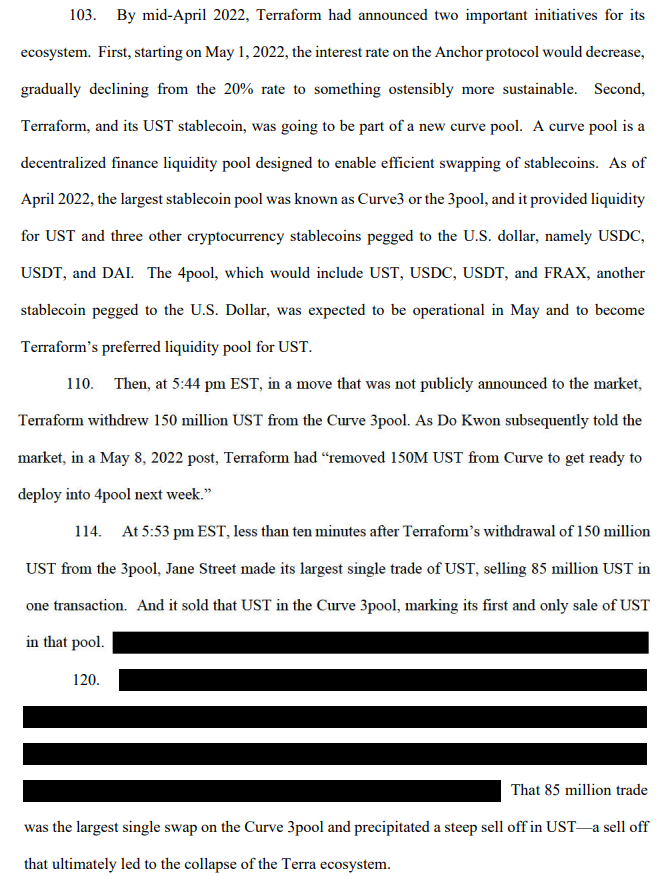
May 8, 2022: Terraform quietly withdrew ~150 million UST from Curve's 3pool (the main liquidity venue for UST alongside USDC, USDT, DAI). This wasn't announced publicly – it was an internal defense mechanism to support the peg.
Minutes later (less than 10 minutes): A wallet linked to Jane Street allegedly executed the largest single UST sale in that pool's history – dumping 85 million UST. The suit claims this massive sell-off, done with advance knowledge of the liquidity removal, was the catalyst that pushed UST below $1 and ignited the death spiral.
This rapid sell-off, the filing argues, was the tipping point that broke UST's peg, triggering a "death spiral" where LUNA's supply hyperinflated to maintain equilibrium, ultimately rendering both tokens near-worthless.
Allegations of Betrayal and Insider Ties
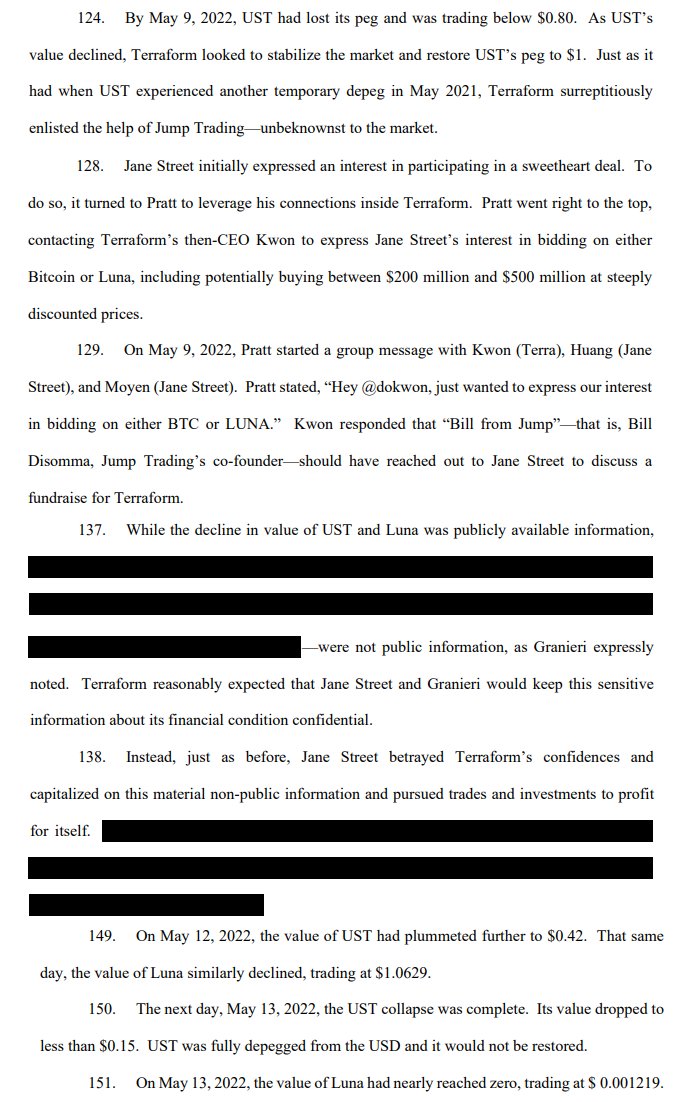
The suit goes beyond the trade itself, alleging a deeper web of interactions. Jane Street executives, including co-founder Robert Granieri and employees like Bryce Pratt and Michael Huang, reportedly engaged in discussions with Terraform leadership, including founder Do Kwon.
These talks included expressions of interest in a potential bailout: Jane Street purportedly considered injecting $200 million to $500 million by purchasing discounted LUNA or Bitcoin reserves. Group chats and communications cited in the complaint suggest Jane Street positioned itself as a possible rescuer, gaining access to sensitive details in the process.
Instead, the lawsuit contends, the firm used this non-public information to "front-run" the market — unloading positions just before the FULL COLLAPSE. Claims include violations of securities and commodities laws, fraud, and unjust enrichment, with Snyder seeking disgorgement of profits, damages, and a jury trial.
Jane Street's Response: 'Baseless' and 'Desperate'
Jane Street has vehemently denied the accusations. In a statement released shortly after the filing, a spokesperson described the suit as "a desperate attempt by a bankrupt entity to extract money through baseless claims." The firm emphasized that its trades were legitimate market activities and that any interactions with Terraform were exploratory and non-binding.
This isn't the first post-collapse legal action against trading firms; a similar suit targeted Jump Trading in 2025, highlighting ongoing efforts to assign blame for Terra's implosion.
Broader Implications for Crypto and Traditional Finance
Filed amid Terraform's ongoing bankruptcy proceedings, the case could provide restitution for creditors if successful. More significantly, it underscores tensions between traditional finance (TradFi) players like Jane Street — a powerhouse in quantitative trading — and the nascent DeFi space.
Experts note that Terra's failure stemmed from multiple factors: its algorithmic design's inherent fragility, unsustainable 20% yields on the Anchor Protocol, and broader market volatility. Yet, if proven, these allegations could prompt stricter regulations on insider trading in crypto markets, where boundaries between public and private information remain blurred.
As of February 24, 2026, the lawsuit is in its early stages, with no immediate rulings expected. It revives debates from the 2022 "crypto winter," a period that saw cascading failures including Three Arrows Capital and FTX.
For investors still holding LUNA Classic (LUNC) or monitoring crypto recoveries, this could signal potential windfalls, or just another chapter in a long saga of accountability. 👀
 Source
 Add to Favorites
 Download image
 Share x
 Copy link
Bitcoin may enter a prolonged sideways phase between $57K and $87K as markets enter a relief period following a 52% drop from ATH. This consolidation could mirror the 2022 fractal, creating liquidity before a potential breakdown toward the $44K–$50K range.
Doctor Profit/2026.03.09

Davinci Jeremie urged people to buy $1 of Bitcoin in 2013 and became a symbol of early conviction. Years later, fame, lifestyle flexing, and token promotions sparked criticism. His journey reflects both crypto foresight and influencer-era controversy.
StarPlatinum/2026.03.04
A sweeping narrative ties Jane Street to India’s expiry-day options case, alleged 10AM Bitcoin sell patterns, Terra’s collapse, and ETF plumbing. While none prove misconduct, critics argue a common structure: move spot, monetize derivatives, keep execution opaque.
Bull Theory/2026.02.27
A controversial narrative links Jane Street, ETF mechanics, and Bitcoin’s price behavior, pointing to lawsuit allegations, 10AM volatility patterns, and derivative hedging dynamics. The discussion raises broader questions about liquidity, structure, and price discovery.
Justin Bechler/2026.02.26
Mean reversion and on-chain models sit at levels historically linked to bottom formation after capitulation. Realized losses reached record USD values, while deviations from anchor models remain extreme. Price pain may be fading; patience remains key.
Checkmate/2026.02.25
Bitcoin didn’t fail as an asset — it matured into an ETF-driven trade. As institutional ownership rose, correlation with tech risk intensified. Short-term pressure reflects holder structure shifts, not thesis collapse.
Eric Jackson/2026.02.24
Hot feeds
A trader profits $448K by monitoring #Binance's new listings!
2024.12.13 17:37:29
Last week, funds have flowed into #Bitcoin, #Ethereum, and #Hyperliquid.
2024.12.16 14:48:36
A $PEPE whale that had been dormant for 600 days transferred all 2.1T $PEPE($52M) to a new address.
2024.12.14 10:35:27
When Elon Musk tweeted about Moltbook, the meme coin MOLT experienced a short-term 30% price surge, hitting a new all-time high of $114 million.
2026.01.31 18:37:29
A smart #AI coin trader made $17.6M on $GOAT, $ai16z, $Fartcoin,$arc.
2025.01.05 16:05:18
A sniper earned 2,277 $ETH ($8.3M) trading $SHIRO within 18 hours!
2024.12.03 23:09:08
MoreHot Articles
How did I turn $1,000 into $30,000 with smart money?
2024.12.09
10 promising AI Agent cryptos
2024.12.05
The 30-Year-Old Entrepreneur Behind Virtual, a Multi-Million Dollar AI Agent Society
2025.01.22
10 smart traders specializing in MEMEcoin trading on Solana
2024.12.09
A trader lost $73.9K trading memecoins in just 3 minutes — a lesson for us all!
2024.12.13
What is $SPORE? Let us take you through the on-chain records to show you how it works.
2024.12.25

