
Lookonchain APP

App Store

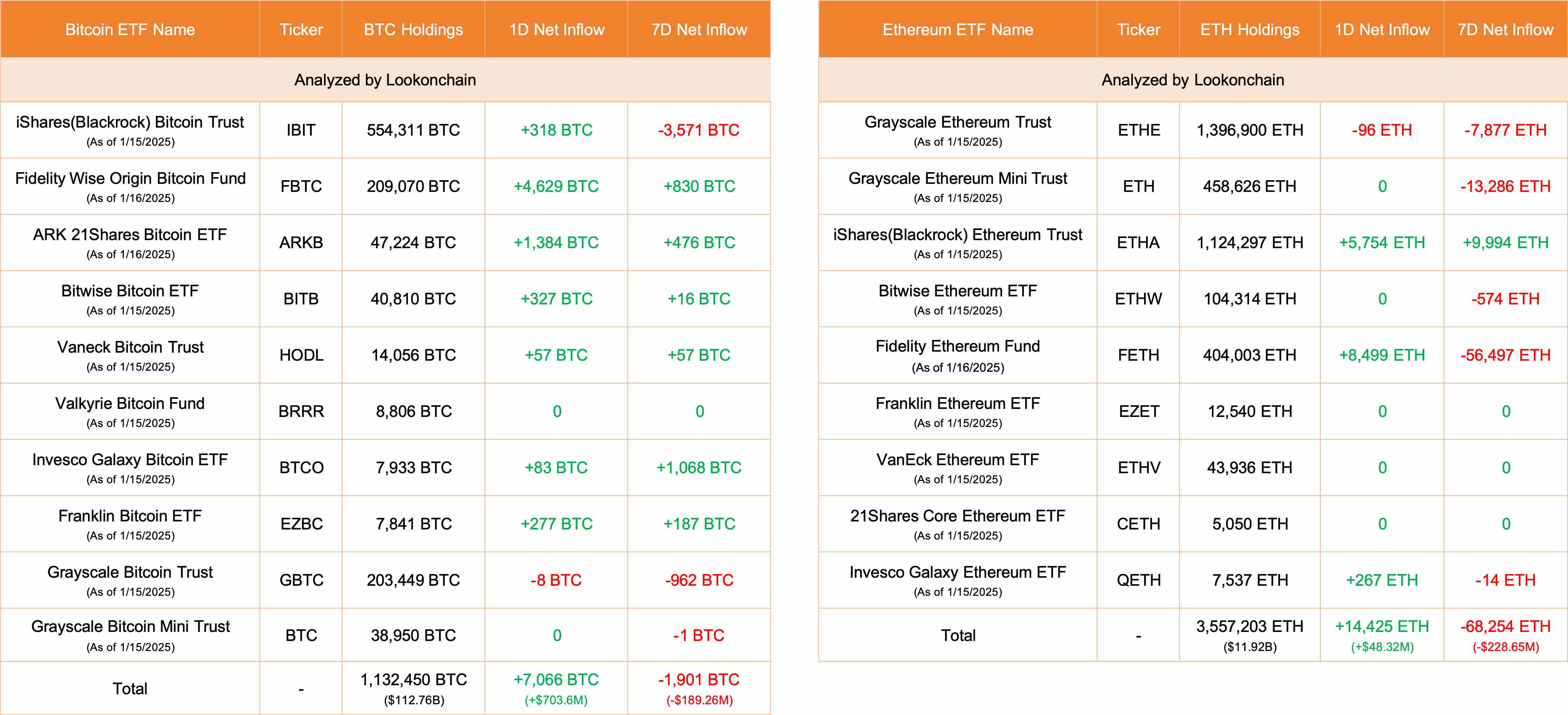
10 #Bitcoin ETFs inflows 7,066 $BTC(+$703.6M) and 9 #Ethereum ETFs inflows 14,425 $ETH(+$48.32M) yesterday.

2025.01.17 00:17:23

Jan 16 Update:

10 #Bitcoin ETFs
NetFlow: +7,066 $BTC(+$703.6M)🟢
#Fidelity inflows 4,629 $BTC($460.97M) and currently holds 209,070 $BTC($20.82B).

9 #Ethereum ETFs
NetFlow: +14,425 $ETH(+$48.32M)🟢
#Fidelity inflows 8,499 $ETH($28.47M) and currently holds 404,003 $ETH($1.35B).
https://x.com/lookonchain/status/1879542825521672397
Relevant content

Israeli Military Strikes Lebanon, Houthis Close Bab al-Mandab Strait Again, Escalation on First Day of Ceasefire

April 9 — On April 8 local time, the first day the U.S.-Iran ceasefire took effect, Israel launched its largest airstrike against Hezbollah since the current conflict began. Iran says the strike violates the ceasefire, adding it has closed the Strait of Hormuz again and is threatening deterrent action against Israeli military targets. The White House announced Tuesday (April 8) that the first round of U.S.-Iran talks will be held in Pakistan on Friday (April 11). But Iran argues three key provisions of the 10-point ceasefire terms have been breached, undermining the “basis for negotiations.”

10 minutes ago

Iran: Hormuz Strait Passage Disrupted, Israel Violates Ceasefire Agreement in Lebanon

April 9 — The Iranian Revolutionary Guard Corps (IRGC) said transit through the Strait of Hormuz has been disrupted over Israeli violations of the Lebanon ceasefire agreement.

10 minutes ago

Iranian Foreign Ministry Accuses US of 'Premature Betrayal' of Agreement Terms

April 9 — Iranian Foreign Ministry Spokesperson Baghaei posted a video on social media Tuesday, showing White House Press Secretary Levitt telling reporters earlier that day that Lebanon is not part of the two-week ceasefire agreement. In the video’s caption, Baghaei asked: “If this isn’t another example of the U.S. once again breaking its word early, then what is?” He also retweeted a post from Pakistani Prime Minister Sharif dated Monday, which stated Iran and the U.S. “have agreed to an immediate ceasefire in all areas, including Lebanon.”

10 minutes ago

Vance: Iran's Ten-Point Plan Resembles AI Editing, Has Multiple Versions

April 9: U.S. Vice President Pence said Iran’s first 10-point proposal is likely drafted by ChatGPT. It was immediately tossed in the trash and rejected. There’s a more reasonable second 10-point proposal rooted in discussions between the U.S. and Pakistan. That’s the one the president referenced, and it remained valid as of yesterday. A third 10-point proposal—even more extreme than the first—has been circulating across social media (Golden Ten).

10 minutes ago

WSJ: Iran Restricts Strait Traffic to Dozens of Vessels per Day

On April 9, The Wall Street Journal reported that Iran has told mediators it will limit daily ship traffic through the Strait of Hormuz to roughly a dozen vessels and impose a transit fee. Arab mediators noted that ships seeking passage must coordinate with Iran’s Islamic Revolutionary Guard Corps (IRGC). S&P Global Platts trade flow data shows only 4 ships were granted passage on Wednesday—the lowest number since April. The approved vessels are currently sailing north along the usual route in the corridor between Iran’s Qeshm Island and Larak Island, near the Iranian coast en route to the Sea of Oman. Shipping operators say fees are typically set a week in advance and tied to vessel size; a very large crude carrier (VLCC) capable of carrying around 2 million barrels of oil can cost up to $2 million. Iran has also proposed splitting the transit fees with Oman, but Oman has not yet agreed to the plan. According to Iran’s Press TV latest updates, the Strait of Hormuz is fully close

10 minutes ago

Analysis: Ceasefire Agreement Makes Fed's Decision Even Trickier

April 9th: In a Wall Street Journal article headlined *“Fed’s Whisperer,”* Nick Timiraos noted the U.S.-Iran ceasefire has offered an opening to address a major threat to the global economy. For the Federal Reserve, however, it may have merely swapped one problem for another: energy prices remain volatile enough to keep inflation uncomfortably high—but not so severe as to crush demand, potentially keeping interest rates on hold longer. Minutes from the Fed’s March meeting emphasized the conflict was not the primary reason holding back rate cuts; rather, it complicated the central bank’s already cautious stance. Even before the war, the path to rate cuts had narrowed: the labor market stabilized (easing recession fears), while progress toward the Fed’s 2% inflation target stalled. The Fed held rates steady at its March gathering, in part due to concerns about prolonged war risks. An escalation could drag down growth and raise recession odds—the last and most compelling case for re

10 minutes ago