
Lookonchain APP

App Store

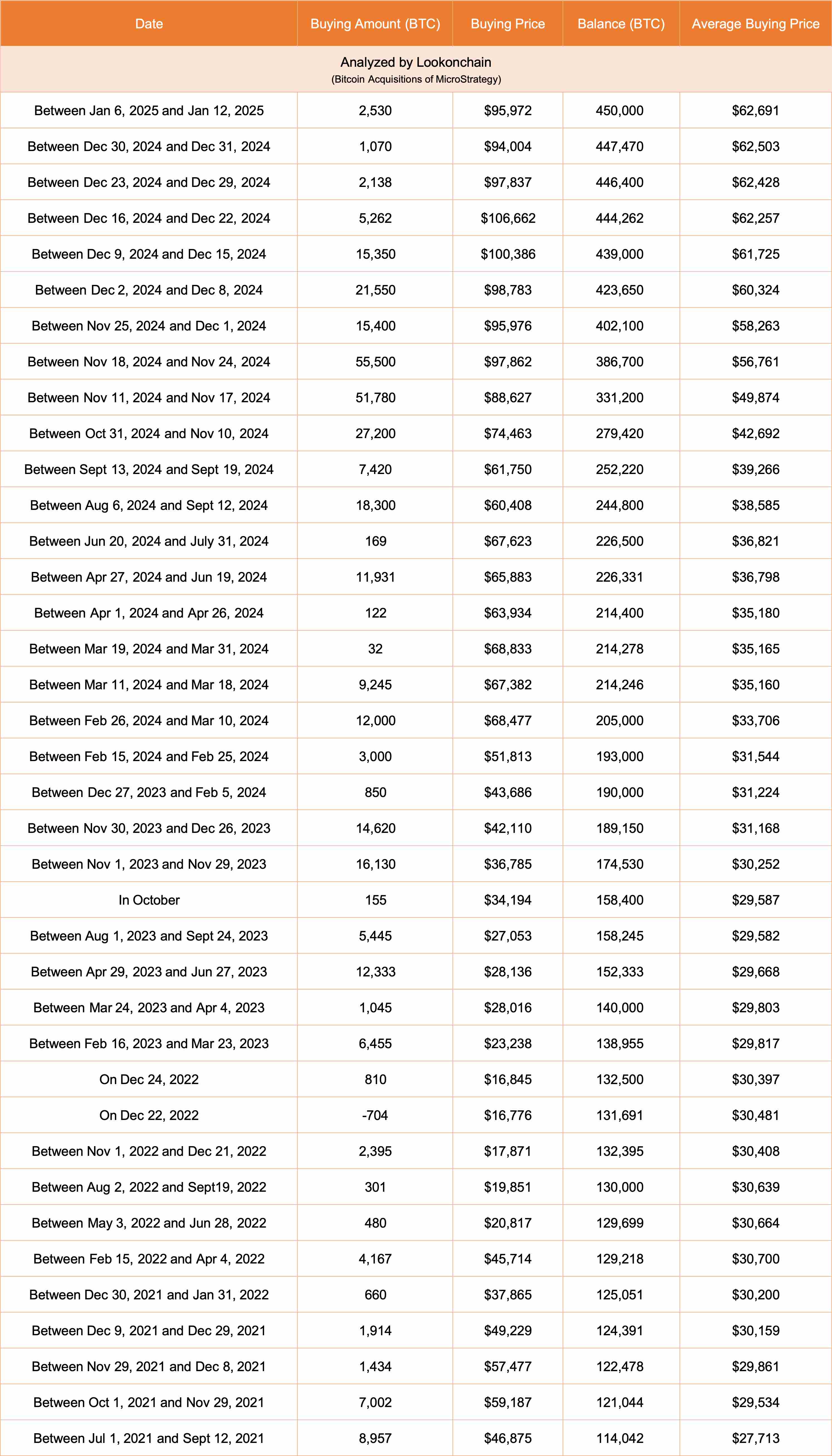
MicroStrategy bought another 2,530 $BTC($243M) at an average price of $95,972 last week!

2025.01.13 22:04:30

MicroStrategy bought another 2,530 $BTC($243M) at an average price of $95,972 last week!

MicroStrategy currently holds 450,000 $BTC($41B), with an average buying price of $62,691.
Relevant content

U.S. military suspends strikes on Iran: Top general says operation has reached its effectiveness limit, Trump faces choice between escalation or diplomacy.

U.S. Central Command Commander Brad Cooper stated that current U.S. military operations against Iran have reached their "effectiveness ceiling" and recommended halting airstrikes on Iranian targets around the Strait of Hormuz. Reports say Cooper’s assessment influenced U.S. President Donald Trump’s decision to pause military operations. Since last Friday, the U.S. has not launched new attacks, and Iran has also suspended military operations targeting Gulf region sites. It is reported that the U.S. military had carried out strikes against Iran for nearly two weeks, significantly weakening Iran’s military deployments around the Strait of Hormuz. Meanwhile, Chairman of the Joint Chiefs of Staff Dan Caine said the U.S. stockpile of interceptor missiles is declining, which could affect the U.S.’ ability to protect its own and allied positions. U.S. Ambassador to the United Nations Mike Waltz said the ceasefire is aimed at "making space for diplomacy." He noted that Trump had previously tried diplomatic channels and now wants to give negotiations another chance. Separately, CBS reported that Iranian officials and Omani counterparts are negotiating to revive the ceasefire agreement and have made progress on reopening the Strait of Hormuz. Meanwhile, the U.S. and the U.K. plan to hold a high-level meeting to discuss forming an international coalition to safeguard shipping security in the Strait of Hormuz. Axios reported that the meeting is expected to take place in London, with U.S. Defense Secretary Hegseth, Dan Caine, and other officials likely to attend. However, some countries have stated they will only consider joining the associated escort coalition after hostilities in the Strait of Hormuz cease. The Trump administration is still facing a critical choice between further military escalation, maintaining the ceasefire, or pushing for a diplomatic resolution.

8 minutes ago

SparkKitty malware has infiltrated Apple and Google’s app stores, and is specifically designed to steal cryptocurrency wallet mnemonic phrases.

According to Check Point, cross-platform malware named SparkKitty has spread through Apple App Store, Google Play, and third-party Android app stores. The malware uses OCR (Optical Character Recognition) technology to scan images in users’ photo albums, targeting sensitive data including cryptocurrency wallet mnemonics, passwords, and QR codes. The report notes that SparkKitty is an upgraded iteration of the earlier information-stealing program SparkCat, disguised as apps such as crypto services, communication tools, and entertainment platforms for distribution. Once installed, the app requests photo album access permission, continuously scans existing and new images, and uploads the extracted text plus device information to the attacker’s server. On iOS, the malicious code was embedded in a crypto application titled “Coin” (Chinese: 币), evading Apple’s app review via code obfuscation. On Android, researchers identified the malware in “SOEX”, a chat and crypto trading app; it was pulled from Google Play only after amassing over 10,000 total downloads. Attackers also spread SparkKitty through additional channels: third-party app stores, sideloaded APKs, modified versions of TikTok, and entertainment apps. Check Point warns that if users save wallet mnemonics as screenshots or photos, their corresponding crypto wallets can be fully controlled by attackers once the mnemonics are stolen. The security agency advises against storing mnemonics in mobile photo albums—instead, they should be kept offline, such as via paper backups or hardware wallet backups. It also recommends users exercise caution when granting photo album permissions to apps and only download applications from trusted sources.

8 minutes ago

U.S. national debt approaches $40 trillion, with investors turning to Bitcoin and gold as safe-haven assets, betting on the U.S. dollar’s depreciation.

As U.S. government debt continues to surge, investors are refocusing on scarce assets like Bitcoin and gold as hedges against the declining purchasing power of the U.S. dollar. Data from the U.S. Treasury’s “Debt to the Penny” shows that as of last Friday, U.S. federal debt has hit a record $39.7 trillion. Market observers point out that U.S. government debt is currently increasing by around $70 billion daily, an incremental volume that exceeds most crypto assets when calculated by market capitalization. The founder of LondonCryptoClub stated that the pace of U.S. debt growth is driving so-called “currency devaluation trades,” in which investors buy assets with limited supplies—such as gold and Bitcoin—to hedge against long-term fiat currency depreciation risks. The firm argues that in an environment of “fiscal dominance,” Federal Reserve policy may be influenced by the government’s financing needs, requiring interest rates to stay low and continuous liquidity provision to support debt refinancing. Apollo chief economist Torsten Slok previously warned that U.S. debt as a share of GDP has exceeded 120%, leaving limited fiscal stimulus room in the event of a future economic recession. Additionally, the Federal Reserve will struggle to cut interest rates sharply as it did in the past, as such moves could exacerbate inflation and push down Treasury yields, hampering government financing. Currently, Bitcoin’s price holds above $65,000, supported by easing U.S.-Iran tensions and falling oil prices, which have lifted market risk appetite. Meanwhile, Ethereum has outperformed Bitcoin recently, with the ETH/BTC exchange rate breaking above its 100-day and 200-day moving averages, leading market participants to believe that altcoin momentum may be building. However, analysts note that since its launch in 2010, Bitcoin’s price movements have resembled those of tech stocks more than traditional safe-haven assets, leaving its safe-haven status a subject of debate.

8 minutes ago

Following ChangXin's IPO, the employee bonus pool promised by its CEO Zhu Yiming amounts to $5.6 billion.

According to the Bloomberg Billionaires Index, the net worth of Zhu Yiming, CEO of ChangXin Technology, surged nearly 300% to $13.9 billion following the firm’s listing. In the company’s May IPO prospectus, Zhu pledged to transfer 767.9 million shares for an employee incentive program. After ChangXin Technology’s stock jumped 466% on its debut trading day, the value of these shares has reached $5.6 billion, equivalent to roughly 40% of Zhu’s total wealth earmarked for employee bonuses. Meanwhile, Zhu also committed not to sell down his shares over the next 10 years. However, ChangXin Technology’s bonus plan comes with specific conditions, including vesting after three years, a 10-year distribution period, and unclear beneficiary scope. The company had 19,298 employees as of the end of 2025.

8 minutes ago

26-year-old Hong Kong trader embezzled HK$50 million to heavily speculate on SK Hynix ETF, suffered a massive loss of HK$150 million with 2x leverage, and was arrested.

A 26-year-old Hong Kong trader is suspected of misappropriating HK$50 million in company funds without authorization as margin, using leveraged financing to purchase the Nan Fung Double Leveraged Long SK Hynix ETF. The trade resulted in a HK$150 million paper loss after the underlying asset plummeted, and he has been arrested by police on suspicion of theft. The trader executed the transactions between January 9 and July 20 this year, leveraging the HK$50 million principal with margin financing to bet on SK Hynix’s price rise. The double leverage of the ETF, when combined with financing, further amplified the risks. Public data shows the Nan Fung Double Leveraged Long SK Hynix ETF climbed to a historical high of HK$193.65 at the end of June, driven by the storage chip rally. However, the semiconductor sector subsequently corrected, and by July 20, the ETF had dropped to HK$52.58, marking a cumulative decline of over 72%. The involved position has not been forcibly liquidated yet, and the final loss may expand amid market fluctuations. The incident has sparked attention in Hong Kong’s Central financial circle, with some clients of related brokerages withdrawing funds for risk aversion. It is understood that the involved firm, Fortune Management Services Limited, is not a licensed institution of the Hong Kong Securities and Futures Commission (SFC). Fortune Securities, another subsidiary under the same Fortune Group, released a statement noting the suspect is not its employee and the incident has no connection with Fortune Securities.

8 minutes ago

Trump Caught in Iran’s Geopolitical Chess Game: Three Options—Military Escalation, Economic Strangulation, or Retreat

According to a New York Times report, U.S. President Donald Trump is facing a tough call on Iran policy. In an interview, Trump stated his only constraint is "moral standards," given he commands the world’s most powerful military. The report notes Trump has recently held multiple discussions on the Iran situation with Vice President JD Vance, Defense Secretary Pete Hegseth, Chairman of the Joint Chiefs of Staff Dan Caine, his son-in-law Jared Kushner, and Middle East envoy Steve Witkoff. Three main options lie before Trump: expanding military operations, applying pressure via economic sanctions, or declaring "victory" and withdrawing. In the prior week, Trump repeatedly hinted at preparing to resume military action against Iran, but shifted his stance on Friday. Multiple officials disclosed internal U.S. government doubts over whether large-scale bombing, cutting Iran’s power supply, and targeting missile facilities could force Iran back to substantive negotiations. Another option is to continue ramping up economic pressure, including restricting shipping in the Strait of Hormuz to cripple Iran’s oil exports. However, analysts argue Trump’s earlier expectation that "sanctions would collapse Iran’s economy" has not materialized. Since withdrawing from the Iran Nuclear Deal in 2018 and implementing the "maximum pressure" policy, the Iranian regime has remained in power, and external fears persist that Iran may further advance its covert nuclear program. The third option is to declare success and withdraw. Trump has previously said he aims to avoid conflict dragging down the U.S. economy via a ceasefire and talks. But if he withdraws without resolving Iran’s nuclear facilities issue and the Strait of Hormuz remains under Iran’s influence, the U.S. could face new energy market risks. Currently, Trump is seeking a balance between military action, economic pressure, and diplomatic withdrawal, and uncertainty lingers over further escalation of the Iran situation.

8 minutes ago