
Lookonchain APP

App Store

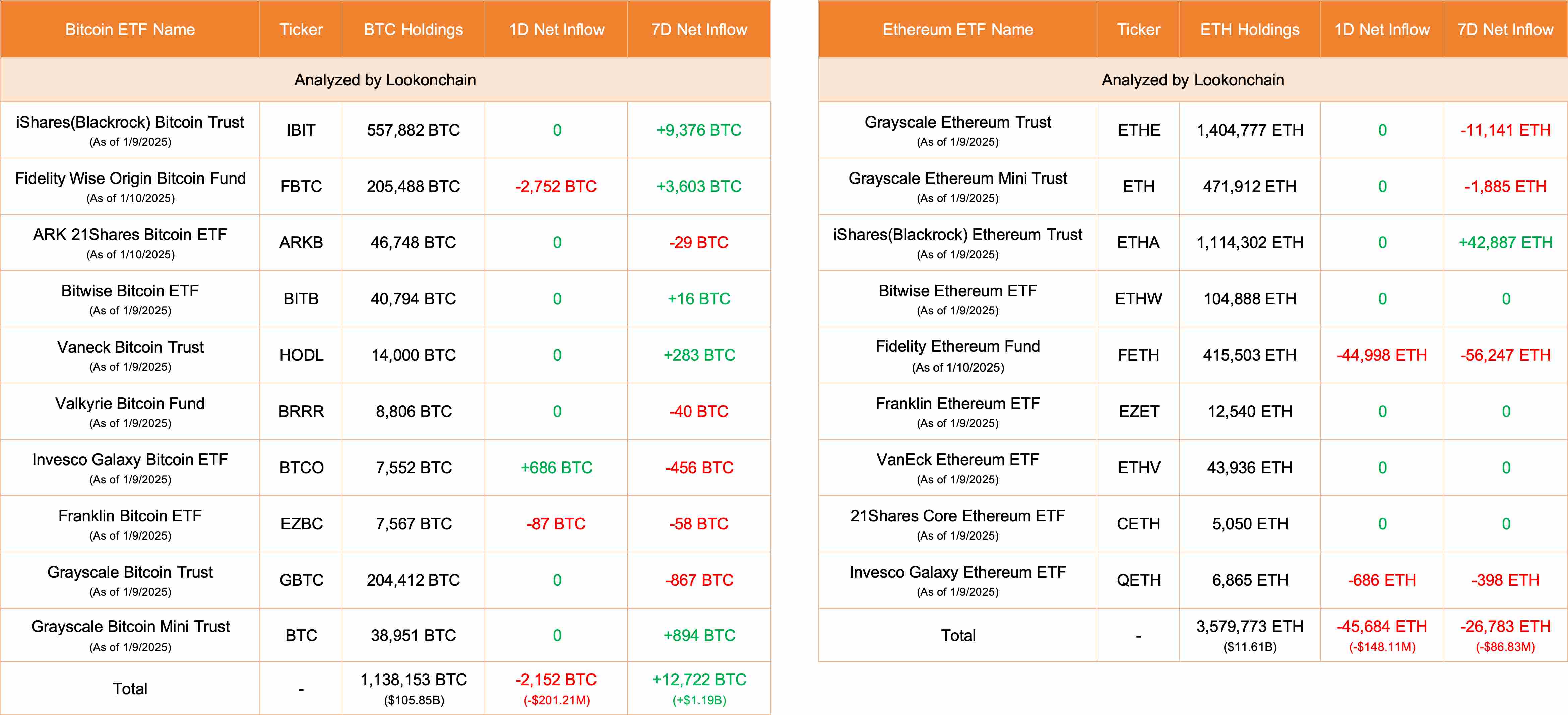
10 #Bitcoin ETFs outflows 2,152 $BTC(-$201.21M) and 9 #Ethereum ETFs outflows 45,684 $ETH(-$148.11M) yesterday.

2025.01.11 00:58:15

Jan 10 Update:

10 #Bitcoin ETFs
NetFlow: -2,152 $BTC(-$201.21M)🔴
#Fidelity outflows 2,752 $BTC($257.26M) and currently holds 205,488 $BTC($19.21B).

9 #Ethereum ETFs
NetFlow: -45,684 $ETH(-$148.11M)🔴
#Fidelity outflows 44,998 $ETH($145.88M) and currently holds 415,503 $ETH($1.35B).
https://x.com/lookonchain/status/1877370746105889201
Relevant content

Serenity published a post mentioning Tianfu Communications, leading to the company’s stock price surging more than 3.9% in a short time.

Recently, Japanese semiconductor test equipment giant Advantest (TSE: 6857) and silicon photonic chip firm OpenLight announced a partnership to co-develop high-volume manufacturing test solutions for silicon photonic devices. The backdrop is the ongoing expansion of AI and high-performance computing (HPC) workloads, which is driving data centers to rapidly adopt silicon photonics and co-packaged optics (CPO) technologies, creating a structural bottleneck in high-volume optoelectronic device testing. OpenLight has raised a total of $84 million in funding to date, with its latest Series A-1 round amounting to $50 million. Serenity noted that OpenLight’s ecosystem is continuing to expand, and its public market partner network is already quite comprehensive, covering Jabil (JBL, which partners with SIVE to advance photonic integrated circuit scaling), Marvell (MRVL) and MaxLinear (MXL) for DSP, Tower Semiconductor (TSEM) for wafer foundry services, and TFC Optical (Tianfu Communication, for optical packaging and assembly). Serenity pointed out that while non-accredited investors cannot directly invest in private companies like OpenLight, given the highly interconnected nature of the optical supply chain, they can still gain indirect exposure to the silicon photonics sector’s growth by investing in the aforementioned related public companies. This partnership will put Advantest head-to-head against Teradyne’s Photon 100 in the optoelectronic testing segment, further intensifying competition in the duopoly of the semiconductor automatic test equipment (ATE) market.

6 minutes ago

Bank of Japan Governor: Will Continue Raising Interest Rates, High Oil Prices May Push Inflation Above the 2% Target

Bank of Japan Governor Kazuo Ueda delivered a speech on Tuesday, making it clear that the central bank will continue to raise interest rates based on economic, price, and financial conditions, and expects to hit the 2% inflation target between the second half of the current fiscal year and the next. Regarding the interest rate hike path, Ueda said the timing and pace of future increases will depend on the likelihood of the baseline forecast being met and related risks, stressing that after recent rate hikes, Japan’s financial environment remains accommodative and continues to support economic activity. On inflation risks, Ueda warned that against high oil prices, potential inflation could exceed the BOJ’s 2% target, and elevated oil prices may also drive broader commodity price hikes. He added that when assessing the impact of the Middle East conflict, the central bank will comprehensively weigh the timing and pace of interest rate hikes. After the announcement, USD/JPY briefly dipped nearly 10 points to 161.66, reflecting rising market expectations for the BOJ’s interest rate hikes.

6 minutes ago

Analysis: Bitcoin OG Selling Drops to Lowest Level in Nearly Two Years, Market Bottom Signs Multiply

On-chain data shows that selling activity by Bitcoin long-term holders (commonly known as "OGs") who have held coins for over five years has plummeted to its lowest level in nearly two years. According to CryptoQuant data, the 90-day average daily selling volume of these veteran investors has dropped to 962 BTC, the lowest since November 2024, falling below the 1,000 BTC threshold for the first time. This shift is significant. Since the start of the current bull market in early 2023, selling pressure from the OG cohort has reached an all-time high for Bitcoin, with massive sell-off peaks in May 2024, February 2025, and September 2025. Daily selling volumes once exceeded 142,000 BTC, exerting notable downward pressure on prices and considered one of the key reasons why Bitcoin struggled to sustain gains after breaking through the $100,000 mark last year. CryptoQuant analysts note that this slowdown in selling is no coincidence: Bitcoin’s current price of around $63,000 is nearly at the break-even point of the most expensive coins likely purchased by OGs five years ago. Holding rather than selling is now the rational choice, meaning a major core selling pressure that had been weighing on prices is substantially easing. Meanwhile, net outflows from spot ETFs have also narrowed significantly over the past two weeks, aligning with the slowdown in OG selling. Multiple contrarian indicators collectively point to a potential market bottom. As of press time, Bitcoin is trading at approximately $62,776, with little change over the past 24 hours.

6 minutes ago

2x Leveraged DRAM to List on Cboe Today, Betting on Global Memory Chip Market

According to U.S. SEC filings, Roundhill Investments and T-REX have jointly launched the Roundhill T-REX 2X Long DRAM Daily Target ETF (ticker: $RAM), which officially began trading today (June 24, 2026) on the Cboe Exchange. Key product details: · Underlying asset: The fund is designed to deliver 2x daily leveraged exposure by amplifying the daily performance of the Roundhill Memory ETF (Cboe: $DRAM) by 200%. · Fees: The fund has a total expense ratio of 1.50% per annum and a net expense ratio of 1.25% per annum; a fee discount arrangement remains in effect through September 30, 2027. · Management: RAM is an actively managed ETF that undergoes daily rebalancing. · Options: Options trading is not currently supported. The fund holds investment exposure exceeding its net assets via leverage. Additionally, $DRAM itself only launched in 2026, so no historical performance or volatility data is available for reference at this time.

6 minutes ago

South Korean stocks closed up over 3%, with Samsung Electronics gaining nearly 10%.

According to Bitget market data, the Nikkei 225 index closed down 613.41 points on Wednesday, June 24, a 0.88% drop, at 69,174.97 points. South Korea’s KOSPI index saw sharp intraday swings: it surged over 4% in early trading, turned negative (down 1%) at one point, then rallied again in the afternoon to gain over 4%, closing up 303.97 points, a 3.71% rise, at 8,507.81 points. Samsung Electronics closed nearly 10% higher, while SK Hynix rose nearly 1%.

6 minutes ago

Qatar’s Prime Minister: US and Iran to set up direct hotline to ensure Strait of Hormuz reopens; Qatar’s LNG production capacity will recover within weeks.

Qatar’s Prime Minister and Foreign Minister Mohammed bin Abdulrahman Al Thani announced that the U.S. and Iran have agreed to establish a direct communication hotline to ensure shipping safety during mine-clearing and navigation resumption in the Strait of Hormuz, and prevent misinformation from disrupting vessel traffic. The mechanism will provide an official verification channel when vessels receive threat alerts, reducing the risk of misjudgment. Mohammed added that as the Strait’s situation stabilizes, Qatar’s liquefied natural gas (LNG) production capacity is expected to return to near-normal operations in the coming weeks. QatarEnergy has completed relevant preparations, but lifting force majeure status entirely remains dependent on meeting Strait security conditions. He noted that shipping volumes in the Strait of Hormuz are expected to return to pre-conflict levels roughly 30 days after the memorandum of understanding (MOU) takes effect, though restoring market confidence will take time. He also warned that the impact of tight supplies of commodities including fertilizers, urea, petrochemical products, and helium is likely to emerge gradually between September and October. Mohammed emphasized that forces within Iran and across various blocs may oppose the agreement and attempt to undermine the process, adding that the current ceasefire and Strait opening arrangements remain fragile, with the real test just beginning. Additionally, the U.S. and Iran have agreed to extend the April 8 ceasefire deal by 60 days and continue advancing nuclear talks. The U.S. also issued an exemption allowing Iran to continue selling oil until August 21 as the first set of economic incentives to encourage its compliance with the agreement.

6 minutes ago