

 App Store
 Profile
 Security
 Sign Out
 Feeds
Feeds
 Articles
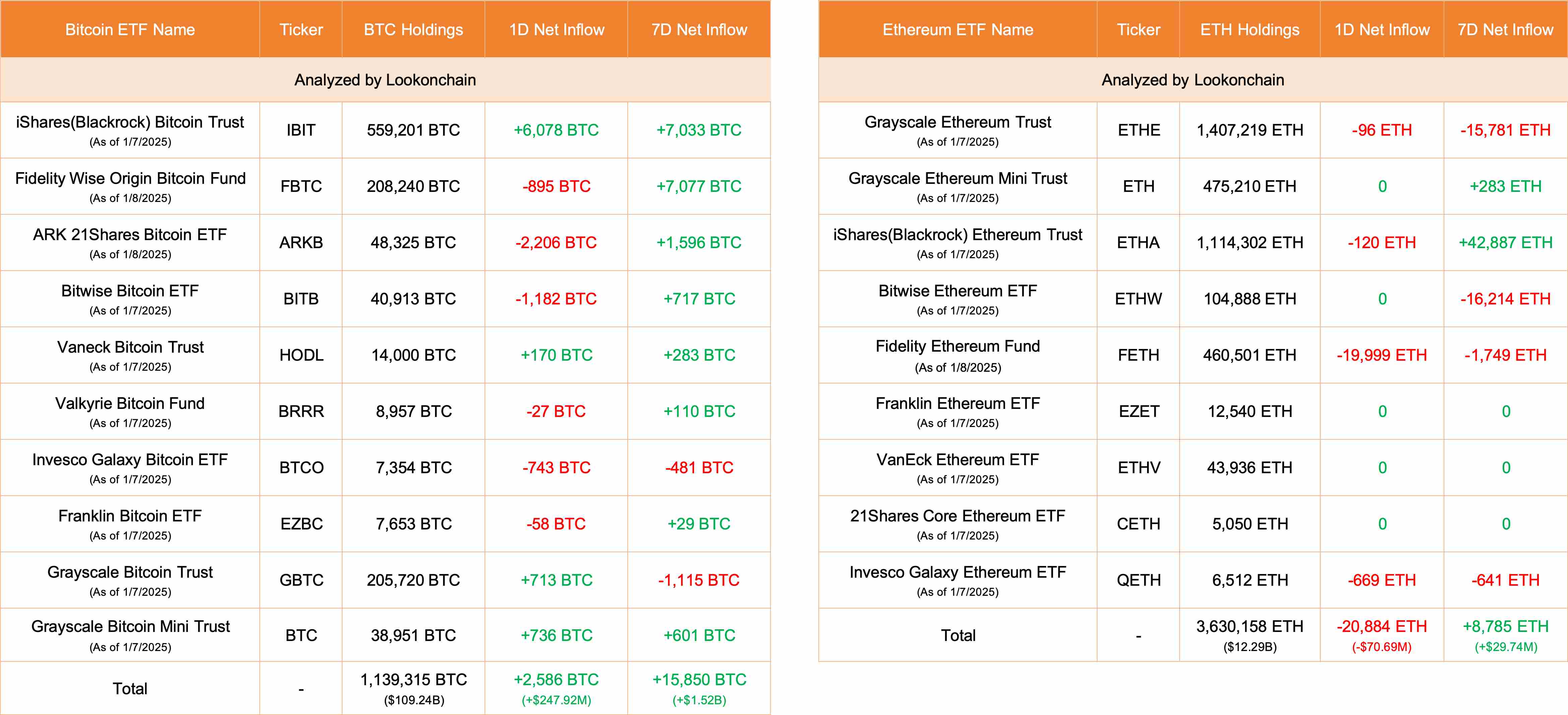
10 #Bitcoin ETFs inflows 2,586 $BTC(+$247.92M) and 9 #Ethereum ETFs outflows 20,884 $ETH(-$70.69M) yesterday.
2025.01.08 23:29:36
Jan 8 Update:
10 #Bitcoin ETFs
NetFlow: +2,586 $BTC(+$247.92M)🟢
#iShares(Blackrock) inflows 6,078 $BTC($582.75M) and currently holds 559,201 $BTC($53.62B).
9 #Ethereum ETFs
NetFlow: -20,884 $ETH(-$70.69M)🔴
#Fidelity outflows 19,999 $ETH($67.7M) and currently holds 460,501 $ETH($1.56B).
https://x.com/lookonchain/status/1876641093862993990
 Source
 Add to Favorites
 Download image
 Share x
 Copy link
Hong Kong-listed storage concept stocks rallied at the opening, with the Southern 2x Long Samsung Electronics ETF surging more than 18%.
8 minutes ago
SK Hynix’s third-quarter operating profit hits a record, and the company plans to return around 100 trillion won to its shareholders, with its stock price surging more than 9%.
8 minutes ago
Bithumb and three other South Korean financial institutions were hacked, with regulatory authorities launching an investigation.
8 minutes ago
A PEPE whale transferred 1.45 trillion tokens after one year, with its remaining holdings boasting an unrealized profit of around $5.106 million.
8 minutes ago
Samsung Electronics and SK Hynix both rose more than 8%.
8 minutes ago
An ancient Ethereum whale has transferred 5,000 ETH to a crypto exchange, worth approximately $11.59 million.
8 minutes ago
Hot feeds
A trader profits $448K by monitoring #Binance's new listings!
2024.12.13 17:37:29
Last week, funds have flowed into #Bitcoin, #Ethereum, and #Hyperliquid.
2024.12.16 14:48:36
A $PEPE whale that had been dormant for 600 days transferred all 2.1T $PEPE($52M) to a new address.
2024.12.14 10:35:27
When Elon Musk tweeted about Moltbook, the meme coin MOLT experienced a short-term 30% price surge, hitting a new all-time high of $114 million.
2026.01.31 18:37:29
A smart #AI coin trader made $17.6M on $GOAT, $ai16z, $Fartcoin,$arc.
2025.01.05 16:05:18
A sniper earned 2,277 $ETH ($8.3M) trading $SHIRO within 18 hours!
2024.12.03 23:09:08
MoreHot Articles

How did I turn $1,000 into $30,000 with smart money?
2024.12.09
10 promising AI Agent cryptos
2024.12.05
The 30-Year-Old Entrepreneur Behind Virtual, a Multi-Million Dollar AI Agent Society
2025.01.22
10 smart traders specializing in MEMEcoin trading on Solana
2024.12.09
A trader lost $73.9K trading memecoins in just 3 minutes — a lesson for us all!
2024.12.13
What is $SPORE? Let us take you through the on-chain records to show you how it works.
2024.12.25

